
Content/SMM Engine
Content that feeds the system instead of sitting beside it
Content/SMM Engine turns what the business already knows into pages, captions, and campaign angles that bring attention back to the website, where the system can capture it.
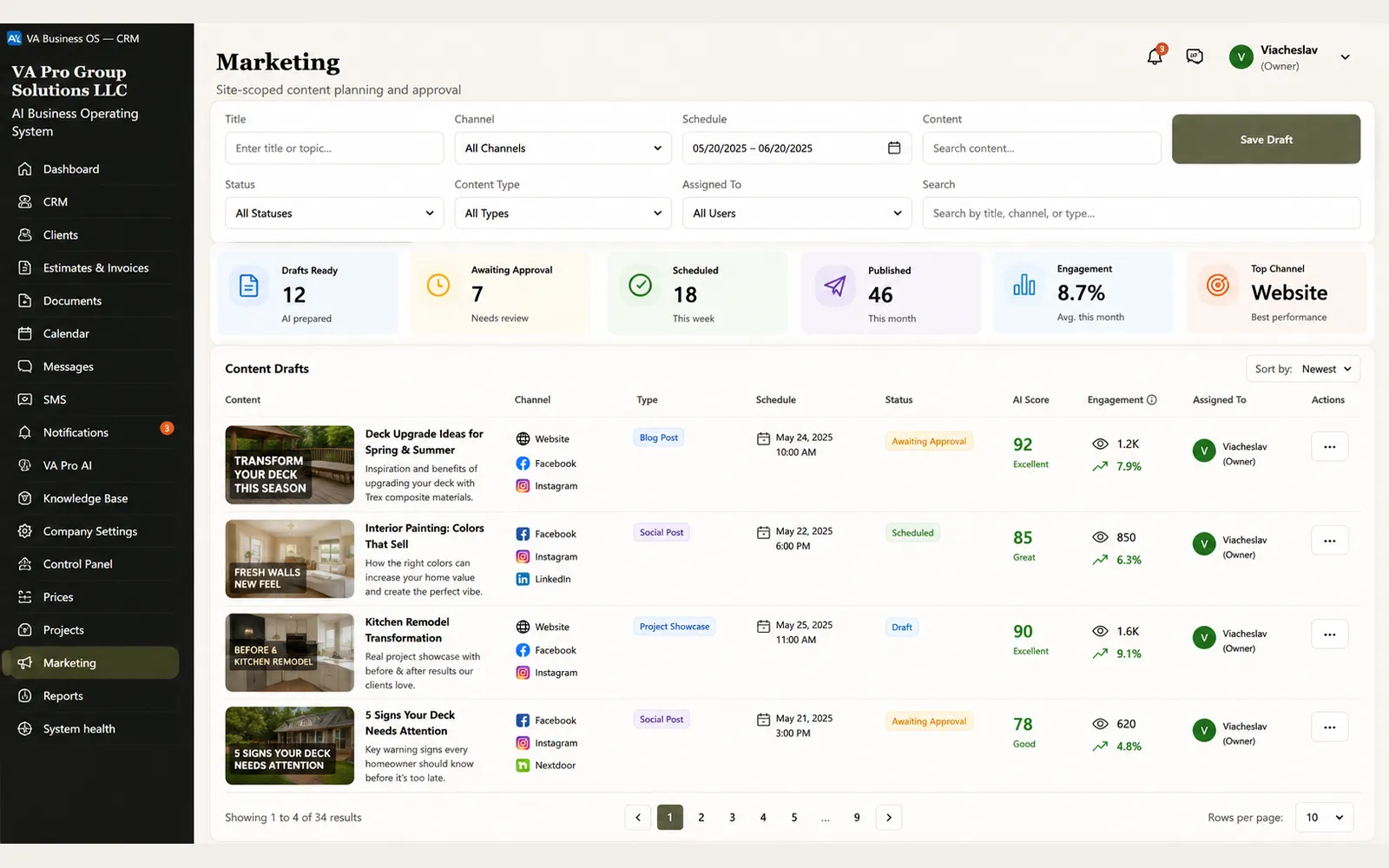
Posting is not the hard part
The hard part is having something worth saying every week, in the same voice, that leads somewhere. Most service businesses either stop after a month or publish posts that never send anyone to the website.
Write once, use it in several places
Page copy, short captions for Instagram, LinkedIn and Facebook, Reels and TikTok hooks, hashtags, campaign angles, and the Open Graph image are written and stored against the page they belong to, so a topic is reused rather than reinvented.
Content should come from what the business actually knows
A service business already produces valuable information every day.
Customers ask questions. Estimates reveal what people misunderstand about pricing. Projects create before-and-after stories. Problems in the field produce useful explanations. Services require decisions about materials, timing, preparation, maintenance, and expectations. The business answers many of the same questions repeatedly — often without realizing that those answers are valuable content.
Content/SMM Engine is designed to turn that existing knowledge into structured material instead of starting every week with the question, “What should we post today?”
A useful content topic should be connected to something real: a service the company provides, a question customers actually ask, a problem the business solves, a project that demonstrates experience, or an explanation that helps a potential customer make a better decision.
From one strong source topic, the business can develop several useful formats.
A detailed website page or article can explain the subject in depth. The same topic can produce a shorter social post, a video hook, a FAQ answer, a search summary, or a campaign angle without requiring the business to invent five unrelated ideas.
This keeps the message consistent across channels while allowing each format to serve a different purpose.
The objective is not to publish more content. The objective is to build a useful body of business knowledge that can be discovered, reused, updated, and connected back to the services the company actually sells.
Build content that can be understood by both people and search systems
Search visibility is no longer limited to a list of traditional Google results.
Potential customers increasingly discover businesses through search engines, AI-generated answers, conversational search tools, social platforms, and other systems that summarize information before the customer ever reaches a website.
That makes clear, factual website content more important — not less.
Content/SMM Engine is designed to keep important business information attached to the pages and topics it actually describes. Services, capabilities, locations, processes, pricing information where appropriate, FAQs, and educational content should be written clearly enough that a person can understand them without needing additional context.
The same clarity also helps search and AI systems determine what the company does, which subjects it has real information about, and which page is the most relevant source for a particular question.
The goal is not to write unnatural “SEO copy” or repeat keywords simply to attract an algorithm.
The goal is to create useful, specific, well-organized information that accurately represents the business.
A strong page should answer the question it was created for. Supporting articles and resources can then deepen that subject, while internal links connect related information across the website.
As that library grows, the website becomes more than a brochure. It becomes a structured source of business knowledge that can support traditional search visibility, AI-assisted discovery, customer education, and future content creation from the same verified information.
One source of truth, adapted for different channels
One of the biggest content problems appears when the website says one thing, social media says another, an old document contains outdated information, and someone creates a new post from memory.
The more channels a business uses, the easier it becomes for its own information to drift.
Content/SMM Engine is designed around reusable source material.
Core facts about the business, services, processes, approved descriptions, page topics, and reusable content can be maintained in a structured way and then adapted for different destinations.
That does not mean copying the exact same paragraph everywhere.
A website page, an Instagram caption, a short video, and an AI-search summary require different formats. But they should still be based on the same underlying facts and positioning.
When an important fact changes, the business should be able to identify the content that depends on it rather than discovering outdated information months later.
This creates consistency without forcing every channel to sound identical.
It also creates a safer foundation for AI-assisted content generation. AI can help draft, summarize, reorganize, and adapt approved information, while the underlying business facts remain the reference point.
The business stays the source of truth. AI and publishing tools remain tools for working with that information — not sources that invent the business on their own.
Start from the page
Content is authored against a real page, so every post has somewhere specific to send a reader.
One topic, several formats
A short caption, a long caption, a video hook, and a set of hashtags come from the same source rather than four separate efforts.
Search and AI summaries
Each page carries its own search title, description, and plain-language summary to make the subject easier for search engines and AI systems to understand and accurately represent.
Images with descriptions
Open Graph and hero images are chosen from the media library with alt text, so links preview correctly and pages stay accessible.
Common questions
Do you write the posts or do I?
Either. The system holds the structure and the angles; who writes the final text is decided per plan. Social media management is part of the Growth and Partner plans.
How is this different from a scheduling tool?
A scheduler publishes what you give it. This decides what to say, keeps it consistent with the website, and points every post at a page that can capture the visit.
Does content help with AI search?
It is written to. Every page carries a plain-language summary and structured data so an answer engine can quote it accurately instead of guessing.
Turn what you know into traffic
Social media management is included in the Growth and Partner support plans. Discovery decides what is worth publishing before anything is scheduled.