Case Studies
What a connected system looks like in practice
VA Pro Studio builds systems around real operating problems rather than generic software templates. The system described below has been built and used in the daily operations of a remodeling business for two years. It connects customer information, projects, communication, documents, client access, operational visibility, a custom business application, and an AI-assisted business layer in one environment. We publish only information we can stand behind. Client-identifying details and specific performance figures are published only when the client approves them for release.

- Business type
- Remodeling business
- Use in production
- 2 years
- System scope
- Website + CRM + Portal + Custom App + AI
- Approach
- Connected operating system
Evidence before claims
A case study should show what was actually built, why it was needed, how the workflow changed, and what can be verified. It should not manufacture a revenue increase, percentage of time saved, conversion improvement, or other performance number simply because a number makes the story sound stronger.
For every case study, VA Pro Studio separates three things:
- What was built.The actual system, application, workflow, integration, or capability that exists.
- What changed operationally.How information, communication, customer work, or decision-making moves differently after implementation.
- What has been measured.Specific quantitative results only when reliable data exists and the client has approved that information for publication.
Client names, private screenshots, confidential business information, and quantitative claims remain private unless there is explicit approval to publish them.
Connected operating system for a remodeling business
The operating problem
The business had customer information, estimates, scheduling, communication, follow-up, project information, and history distributed across a phone, spreadsheets, shared inboxes, and separate software tools.
Each tool handled a piece of the operation, but the customer relationship and the project did not move through the business as one connected record.
That created recurring operational problems.
The same information could need to be entered more than once.
Follow-up depended on someone remembering to do it.
A customer or project question could require checking several different places before finding the answer.
Documents, previous conversations, project details, and decisions did not always live together.
The Owner did not have one environment showing what was active, what was waiting, what had stalled, and what required attention.
The problem was not a lack of software.
The problem was that the software, information, and workflows did not operate as one system.
What was built
VA Pro Studio developed a connected operating environment around the customer, project, and business record.
The implementation includes:
- public website and inquiry capture
- customer and lead records
- project and job information
- estimate and document context
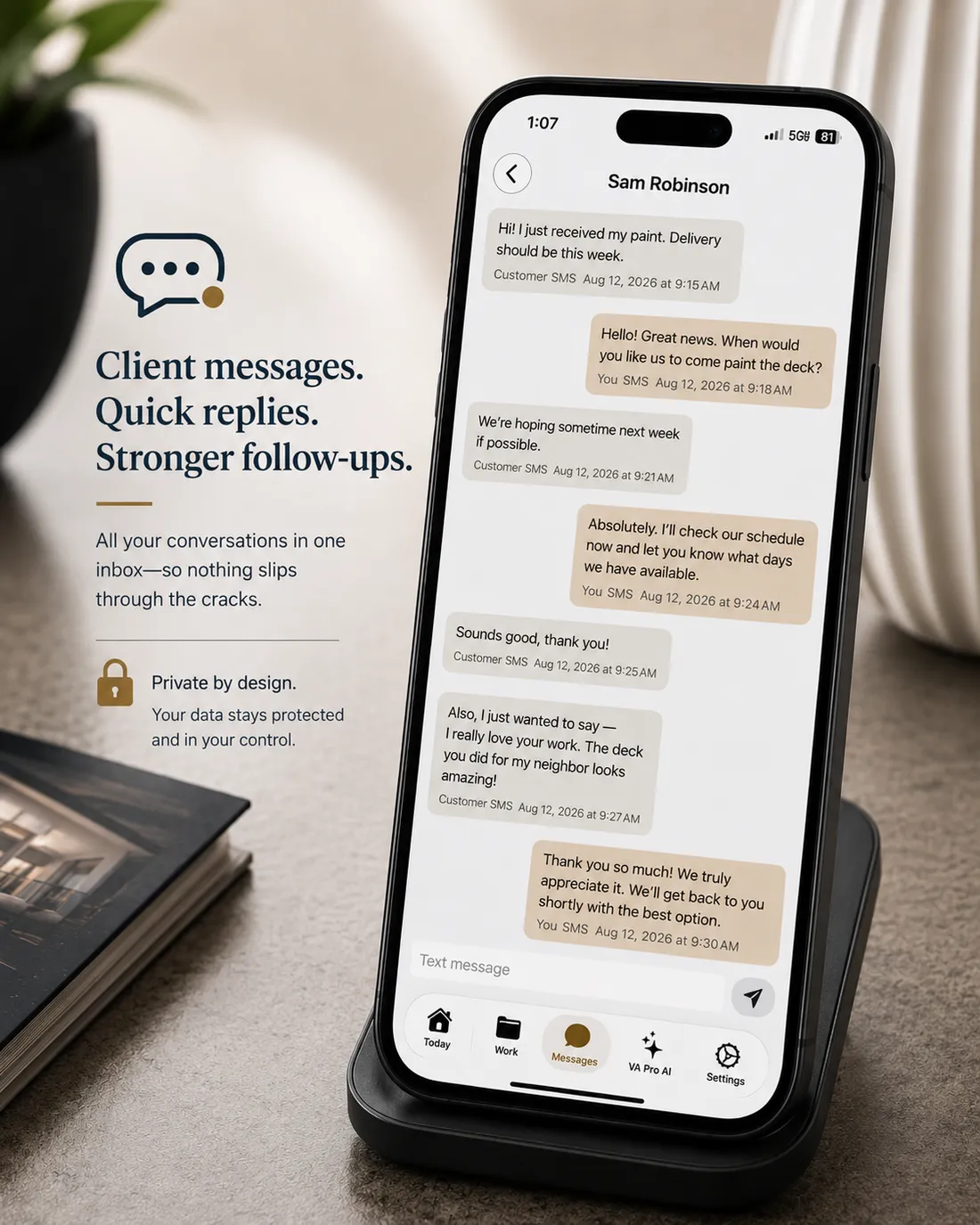
- communication and activity history
- scheduled follow-up
- client-facing approvals and documents
- client portal access
- owner reporting and operational visibility
- support and request history
- a custom business application designed around the company's own workflows
- an AI business assistant connected to approved business context
These parts are not treated as unrelated products.
They are designed to work from shared customer, project, and operational information.
A custom application for the business
Standard software does not always match the way a real company operates.
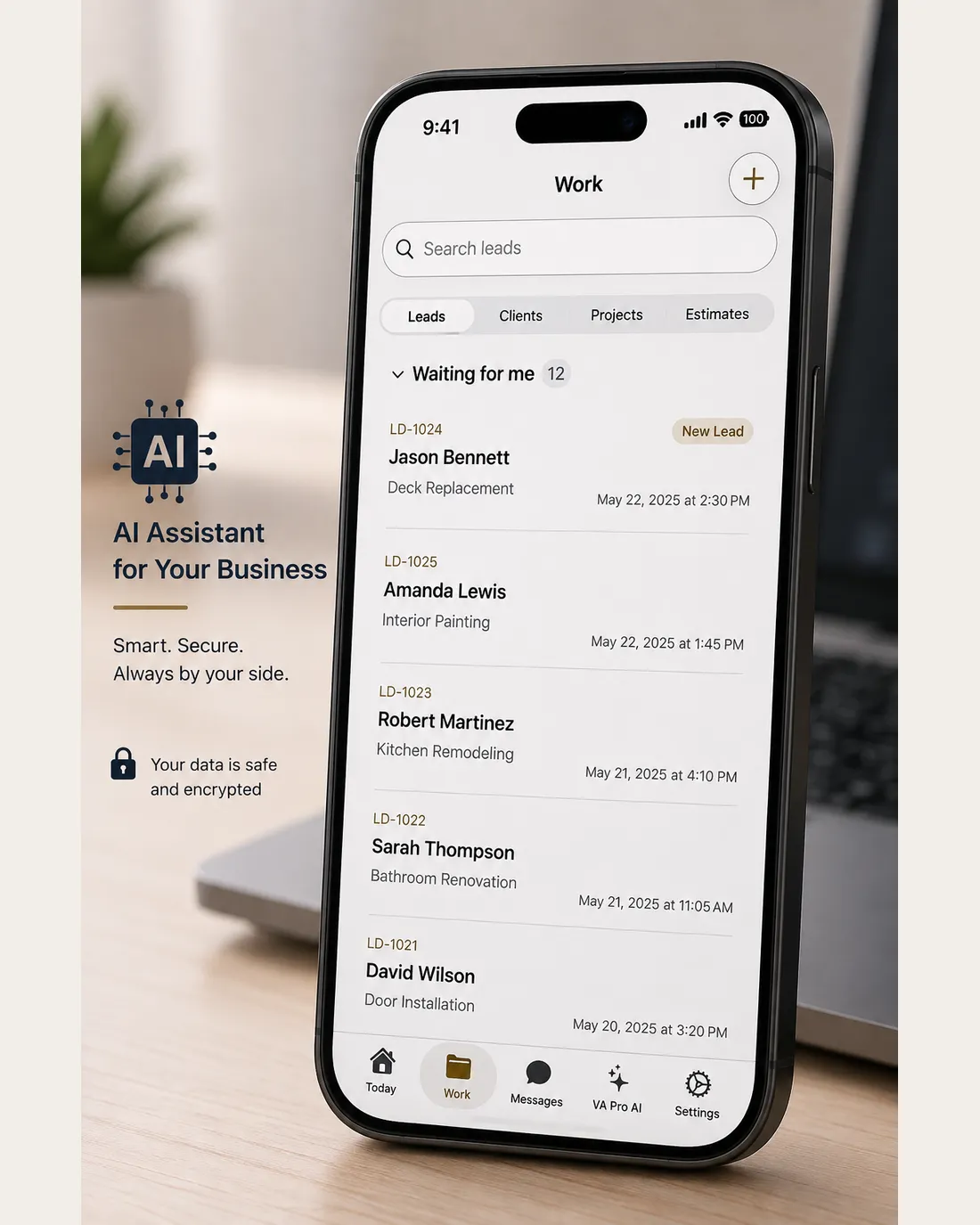
For this remodeling business, VA Pro Studio also developed a custom application that gives the Owner access to key business information and operational functions in one environment.
Instead of moving between multiple unrelated systems to understand what is happening, the application brings together the information needed to manage customers, projects, activity, business processes, and current priorities.
The application is built around the way the company actually works rather than forcing the company to change its processes to fit a generic software product. It also creates a foundation for additional capabilities to be added as the business evolves.

An AI assistant that does more than wait for a question
The AI layer is designed to be different from a generic chatbot.
A traditional AI assistant usually waits for a person to ask a question or give an instruction.
A business assistant can be more useful when it understands approved company context and can help surface what deserves attention.
The AI business assistant is designed to work with relevant information already available inside the system and help the Owner by:
- summarizing business and project context
- identifying items that may require attention
- surfacing open issues or stalled activity
- comparing available information
- preparing possible next steps
- suggesting options for the Owner to consider
- helping organize priorities
- preparing drafts and summaries
- bringing relevant business information forward without requiring the Owner to search for it manually
For example, instead of waiting for the Owner to ask: “Is there anything I need to follow up on?” — the system can be designed to recognize situations that appear to need attention and present them for review.
Instead of only answering: “What should I do?” — it can help present several possible actions based on the available business context.
The AI does not replace the Owner's authority.
Its role is to help the Owner see more, understand faster, and consider options before making the final decision.
Financial, legal, security-sensitive, access-changing, and irreversible actions remain subject to defined human approval.
How the workflow changed
Before the connected system, finding the answer to a customer or project question often depended on knowing which tool, inbox, spreadsheet, or person contained the information.
The connected workflow creates a clearer path:
Inquiry → Customer Record → Estimate / Project → Communication → Documents / Approval → Client Access → Follow-Up → Ongoing Business Context
Information generated at one stage can remain connected as the work moves forward.
The customer does not have to become a completely new record every time the project reaches another part of the business.
The Owner does not have to reconstruct the history from several disconnected systems every time a decision needs to be made.
The custom application provides the operational workspace. The connected records provide the context. Automation can support repeatable workflows. The AI assistant can help interpret that context and surface possible next steps.
The value is not one individual screen or feature.
The value is that these parts can work together around the same business.
What this architecture makes possible
A connected system creates a foundation that can continue to expand as the business changes.
New workflows, integrations, dashboards, automation, reporting, custom application functions, and AI-assisted capabilities can be added around the same underlying business context rather than introduced as another disconnected tool.
That allows the technology to evolve with the company.
The objective is not to automate everything or replace every existing service. It is to determine where connected information, custom development, automation, and AI create a meaningful operational advantage.
What we can verify
This system has been used in daily production by the remodeling business for two years.
The implementation and the capabilities described here reflect work that has actually been developed and used.
VA Pro Studio does not publish invented:
- ROI percentages
- revenue increases
- conversion improvements
- hours-saved claims
- performance guarantees
- client-identifying information
Specific quantitative results are published only when they have been measured appropriately and approved by the client for public use.
Where evidence exists, we show it. Where it does not, we describe the system without manufacturing a result.
How case studies are documented
Every VA Pro Studio case study is intended to answer four questions:
The goal is to document real work rather than turn every project into a marketing claim.
What was the operating problem?
What was difficult, disconnected, repetitive, or difficult to control before the system was built?
What was implemented?
Which systems, applications, workflows, integrations, or capabilities were actually created?
What changed in the operation?
How does information or work move differently after implementation?
What evidence supports the claim?
What can actually be demonstrated, measured, or verified?
Common questions
Why does the case study not name the client?
What a client has already made public - their own website, for instance - can be shown as our work. Their internal operation is a different matter: private screenshots, business data, and performance figures are published only with that client's approval, and this case study describes the work without them.
Can I speak to a reference?
A reference may be requested during Discovery. Any introduction depends on the client agreeing to it and is handled separately from permission to publish a case study.
Do you build only for remodeling companies?
No. VA Pro Studio builds connected systems for service businesses whose operations involve customers, inquiries, projects, communication, documents, follow-up, internal workflows, or other processes that benefit from being connected. The exact architecture depends on how the individual business operates.
Can you build a custom application for my business?
Yes, when a custom application is the appropriate solution to the operating problem. The purpose of custom development is not to recreate standard software unnecessarily. It is used when the business needs a workflow, interface, operational tool, or capability that existing software does not handle well.
Can AI be built around my business too?
AI-assisted capabilities can be designed around approved business context when they provide a practical operational benefit. The appropriate AI scope, available capabilities, provider requirements, data boundaries, and approval rules are defined as part of the project rather than promised as a generic package.
Ask about work like yours
Tell us how your business operates and where information, follow-up, customer work, or internal processes currently break down. If we have built something comparable, we will explain what was involved, what worked, and what the system did — without inventing results that cannot be verified.